Wednesday, December 12, 2018

RidgeRun supporting The 2019 FIRST® Robotics by providing NVIDIA Jetson support

RidgeRun love helping academic projects! RidgeRun is proud to help the teams on FIRST Robotics Competition [1] with software for embedded systems to improve the acquisition, processing and analysis of Audio and Video signals!

[1] https://www.firstinspires.org/robotics/frc

Michael, Amanda, and Emily (in the pic below) of FIRST Robotics Competition Team 102, The Gearheads, from Somerville High School in NJ, investigate the NVIDIA Jetson technology from RidgeRun.  They hope that the combination of Nvidia TX1, Auvidea J90LC, and drivers from RidgeRun will provide a cost effective, state of the art Computer Vision solution for the 2019 season. Go Gearheads!


RidgeRun help getting the kernel built with the IMX219 V4L2 driver for TX1 on the Auvidea J90-LC for state of the art Computer Vision solution for The 2019 FIRST® 2019 season.

Watch out! and we will keep updating as the Competition progress.

For more information please contact us at support@ridgerun.com or for purchase related questions post your inquiry at our Contact Us page.


Monday, December 10, 2018

RidgeRun - NVIDIA Xavier - Deep Learning Tutorials using Jetson Inference

Jetson-inference is a training guide for inference on the TX1 and TX2 using NVIDIA Deep Learning GPU Training System (DIGITS)

This blog details the summary of original Jetson-inference training from NVIDIA with a focus on inference part.

You can learn about following details in this developer wiki from RIdgeRun Engineering : NVIDIA Xavier - Deep Learning - Deep Learning Tutorials - Jetson Inference

Building jetson-inference.

Classifying Images with ImageNet.

Locating Object Coordinates using DetectNet.

Image Segmentation with SegNet.

and run a Live Demo.

With jetson-inference you can deploy deep learning examples on the NVIDIA Xavier in a matter of minutes. An example application is shown below.

The input is an image and it outputs the most likely class and the probability that the image belongs to that class using ImageNet classification network. ImageNet is a classification network trained with a database of 1000 objects.


Fig1: imagenet-console output image

It detects the image as 'Boston bull, Boston terrier' with imagenet class id of 0195 at 96.305% classification accuracy. Image recognition networks output a class probabilities corresponding to the entire input image.

Detection networks, on the other hand, find where in the image those objects are located. DetectNet accepts an input image, and outputs the class and coordinates of the detected bounding boxes.


                            Fig2: detectnet-console output image using coco-dog pretrained model


If you are new to the Xavier or planning on getting one, please visit our Jetson Xavier Wiki page.

Article related : 

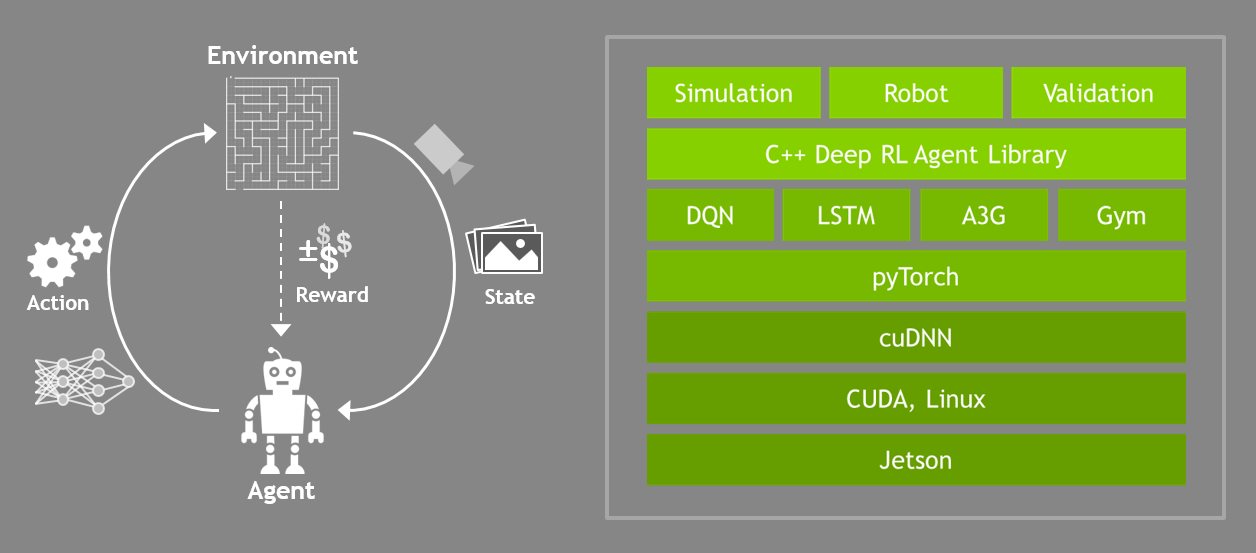
Read this blog on deep reinforcement learning Deep Reinforcement Learning on the Jetson Xavier

For more information please contact us at support@ridgerun.com


Thursday, November 15, 2018

Testing Deep Reinforcement Learning on the Jetson Xavier with PyTorch


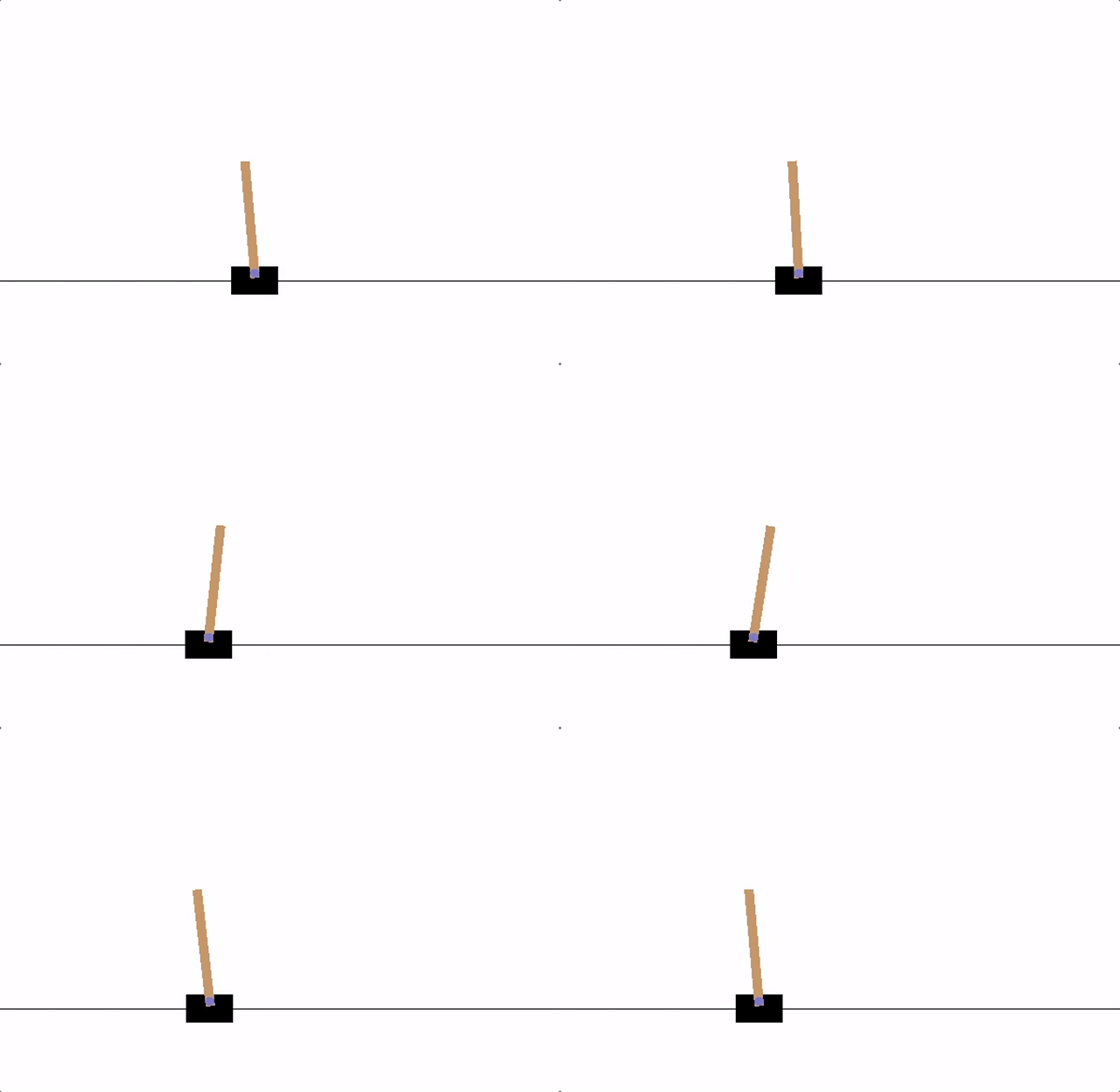
Jetson-reinforcement is a training guide, provided by NVIDIA, for deep reinforcement learning on the TX1 and TX2 using PyTorch. The tutorial is not currently officially supported on the Jetson Xavier. We provide instructions to get the Deep Q Learning 'cartpole' demo running on the Xavier.

The objective of this example is to balance a pole that is attached by an un-actuated joint to a cart, which moves along a friction-less track. Deep Q Learning solves the problem by generating actions based just on pictures of the environment and the received reward.


If you want to test this demo on your Xavier please visit our  jetson-reinforcement wiki page.
If you are new to the Xavier or are planning on getting one please visit our Jetson Xavier wiki page.

Monday, November 12, 2018

Working with CUDA on the Jetson Xavier

A lot of CUDA samples are included , one of these samples is imageDenoising. This sample demonstrates two adaptive image denoising techniques: KNN and NLM, based on computation of both geometric and color distance between texel


Check out the samples included with CUDA and what they do in CUDA Samples.

If you are new to the Xavier or are planning on getting one please visit our Jetson Xavier wiki page.

Thursday, November 8, 2018

Tuning Jetson Xavier's Performance

The JetPack provides the tegrastats utility program which reports memory, processor and gpu usage, power consumption and temperature for Tegra-based devices.


The JetPack also provides with a command line tool called nvpmodel which can modify the performance for a given power budget. It provides power budgets for 10W, 15W, 30W and a no-budget mode for max performance. This will modify number of CPUs online, maximum frequency for CPU, GPU, DLA, PVA and number of online PVA cores. Values set by nvpmodel will persist across power cycles.


Finally the jetson_clocks.sh script provides the best performance for the current nvpmodel by setting the clock frequencies to the max frequency and disabling dynamic frequency scaling.


For examples on how to use this utilities please visit performance tuning wiki page.

If you are new to the Xavier or are planning on getting one please visit  Jetson Xavier wiki page.

Tuesday, November 6, 2018

RidgeRun - GStreamer Deep Learning inference plugin: GstInference

GstInference is an open-source project from RidgeRun Engineering that provides a framework for integrating deep learning inference into GStreamer.

Check out the presentation from RidgeRun Engineering team about our latest development on GstInference at Edinburg GStreamer Conference 2018.

GstInference: A GStreamer Deep Learning Framework : https://gstconf.ubicast.tv/videos/gstinference-a-gstreamer-deep-learning-framework/


For more information please contact us at support@ridgerun.com


Deploying Deep Learning on the Jetson Xavier using the Deep Learning Accelerator

jetson-inference is a training guide for inference and deep learning on Jetson platforms. It uses NVIDIA TensorRT for efficiently deploying neural networks.The "dev" branch on the repository is specifically oriented for Jetson Xavier since it uses the Deep Learning Accelerator (DLA) integration with TensorRT 5.


With jetson-inference you can deploy deep learning examples on the Xavier in a matter of minutes. Some of the example applications are showed below.


ImageNet is a classification network trained with a database of 1000 objects. The input is an image and it outputs the most likely class and the probability that the image belongs to that class.


Image recognition networks output a class probabilities corresponding to the entire input image. Detection networks, on the other hand, find where in the image those objects are located. DetectNet accepts an input image, and outputs the class and coordinates of the detected bounding boxes.


For more examples and a tutorial on how to get jetson-inference running in your Xavier please visit our jetson-inference wiki page.

If you are new to the Xavier or are planning on getting one please visit our Jetson Xavier wiki page.